Key Takeaways
- ETFs offer simple diversification in a single investment: Investors can gain exposure to a wide range of assets (stocks, bonds, commodities) without needing to buy each individually.
- Low costs and accessibility have driven their rapid growth: ETFs are typically cheaper than actively managed funds and can be traded easily on stock exchanges like regular shares.
- ETFs have become core building blocks for modern portfolios: They are widely used by both beginners and experienced investors to access markets efficiently and build diversified portfolios.
The Rapid Growth of ETFs in Modern Investing
Exchange-Traded Funds, commonly known as ETFs, have become one of the fastest-growing investment products in the world. Over the past two decades they have become a core part of many investment portfolios, used by both new investors and experienced professionals.
An ETF is a type of investment fund that trades on a stock exchange in much the same way as an individual company share. When investors buy an ETF, they are purchasing a single investment that typically holds a collection of assets. These assets might include stocks, bonds, commodities, or a combination of different investments.
This growth has been substantial. According to industry data from BlackRock and ETFGI, global ETF assets have grown to more than $11 trillion, reflecting how widely these products are now used by investors around the world.
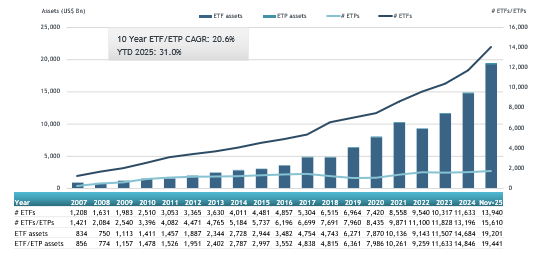
Source ETFGI Global ETF Industry Insights / BlackRock Global ETF Landscape
(Past performance is not indicative of future performance)
Why Diversification Matters
One of the key ideas behind ETFs is diversification. Rather than buying shares in a single company, investors gain exposure to many companies or assets through a single investment. For example, some ETFs track major stock market indices. When investors buy an ETF that tracks an index, they effectively gain exposure to the performance of that broader market rather than relying on the success of one individual company.
This approach can reduce the risk associated with concentrating investments in a single stock. If one company performs poorly, the impact may be smaller because the ETF holds many different holdings within the portfolio.
Learn more about ETFs and how to trade them with EC Markets.
Easy Access to Global Markets
ETFs are also known for their transparency and accessibility. Because they trade on stock exchanges throughout the day, investors can buy or sell them in the same way they would trade ordinary shares. This flexibility has made them particularly attractive to many modern investors.
Lower Costs Compared to Traditional Funds
Another reason ETFs have grown in popularity is cost efficiency. Many ETFs are designed to track indices rather than relying on active fund managers trying to outperform the market. As a result, management costs are often lower than those associated with traditional actively managed funds.
Costs can differ significantly between investment approaches. Industry research from Morningstar shows the average expense ratio for passive ETFs is often below 0.20%, compared with around 0.60% or more for actively managed funds.
Source: Morningstar Global Fund Fee Study
How ETFs Fit Into a Portfolio
Today, ETFs exist for a wide range of investment strategies. Some track broad stock markets, while others focus on specific sectors, regions, or investment themes. There are ETFs that track technology companies, emerging markets, commodities such as gold, and even particular economic trends.
For investors building a portfolio, ETFs can offer a convenient way to gain exposure to different parts of the market without needing to purchase a large number of individual investments. Many investors use them as core building blocks within diversified portfolios.
As financial markets continue to evolve, ETFs have become an increasingly common way for investors to access global markets in a simple and flexible format. In the UK, ETFs are becoming increasingly popular among retail investors, with continued inflows and growing adoption across major platforms, according to the Investment Association and London Stock Exchange. The number of UK ETF investors also grew significantly, reaching around 2.1 million in 2025, more than doubling since 2022.
Source: BlackRock People & Money ETF UK Report
Our goal is to provide investors with access to a wide range of financial markets and investment opportunities, helping individuals explore different ways to build and diversify their portfolios over time.